
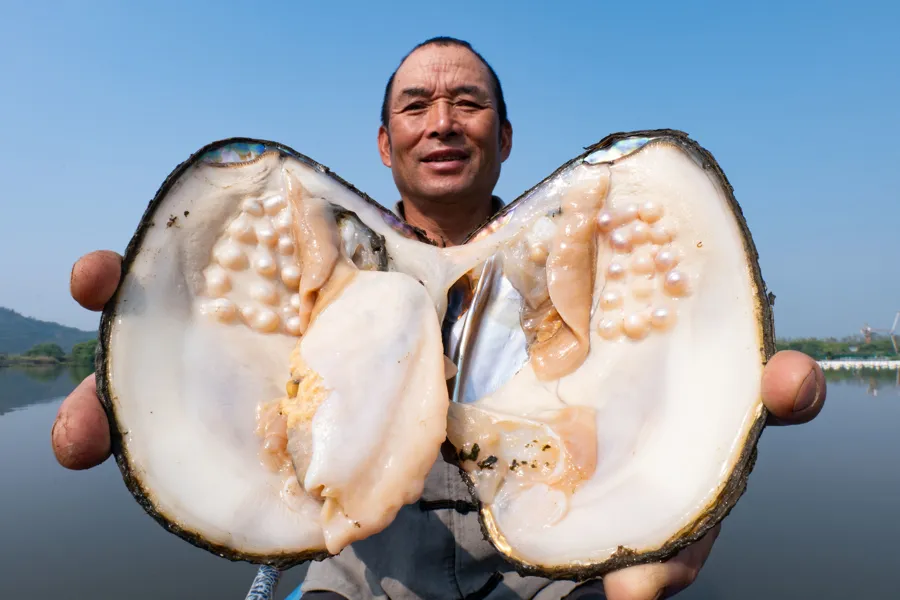
I was born in Suzhou, right on the shores of Lake Taihu.As a child, my grandfather would often point at the water and say, "There are treasures hiding down there." Back then, I thought he meant fish. It wasn't until I grew up that I understood — he was talking about pearls. Those luminous, warm-to-the-touch gems that grow inside freshwater mussels, deep beneath the surface.
Suzhou has been cultivating pearls since the Song Dynasty (960–1279 AD). Now, I want to tell you the story of one pearl ,from the moment it begins as a tiny piece of tissue, to the moment it rests on your wrist as a finished strand.
Planting a Seed
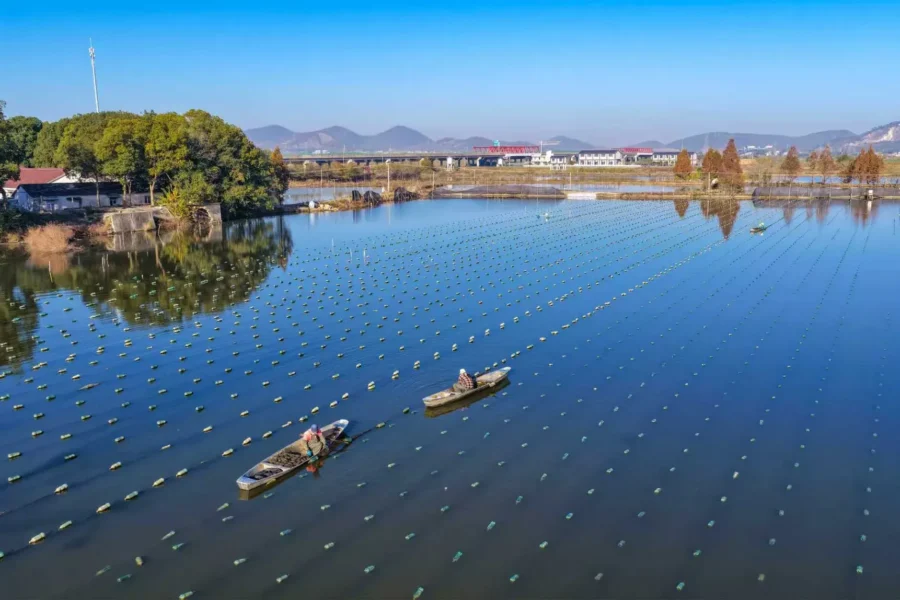
Our story begins at a pearl farm on the edge of Lake Taihu. It's March, and the water still carries a winter chill. Wang, a pearl farmer who has worked these waters for forty years, rows his small boat to the suspended cultivation lines in the middle of the lake. Beneath the surface hang rows of triangle-shell mussels, quietly filtering plankton from the water. They've been growing here for two years.Today, Wang has an important job to do, grafting.He pulls up a mature mussel, gently pries open its shell with a tool, and makes a small incision in the mantle tissue. Then he inserts a tiny piece of donor mantle tissue, about the size of a grain of rice, into the cut. This is called nucleation. Without this piece of tissue, the mussel will never produce a pearl.
"Does it hurt?" I asked him when I was a child.He laughed. "A mussel can't talk, but it knows how to protect itself. It feels something foreign inside, so it starts wrapping it, layer by layer. And over time, that wrapping becomes a pearl."It's a lot like life, isn't it? The things that irritate us the most can sometimes turn into something beautiful, if we give them enough time.
A Secret Growth Beneath the Water
For the next three years, the mussel hangs in the lake, doing what it does best — growing.Lake Tai's water is the perfect nursery for pearls. In summer, rising temperatures trigger a bloom of plankton. The mussels feed heavily, and their nacre-secreting metabolism speeds up. By autumn, as the water cools, growth slows — but the nacre becomes denser, finer, and more lustrous.
Wang patrols the lake every few days. He pulls up the lines, checks the mussels' health, and scrubs off algae and snails that cling to the shells. When heavy rain hits, he worries about murky water. When a heatwave strikes, he worries about oxygen levels."Raising pearls is really about raising water," Wang says. "Good water means good mussels. Good mussels mean good pearls."
Over three years, that tiny piece of tissue transforms into a pearl sac inside the mussel. Layer by layer, the sac deposits nacre, a combination of calcium carbonate and conchiolin. Each layer is only a few hundredths the thickness of a human hair. But day after day, year after year, those layers build up into a solid, luminous gem.My grandfather used to call pearls "crystallized time." A good pearl has no shortcuts
The Harvest
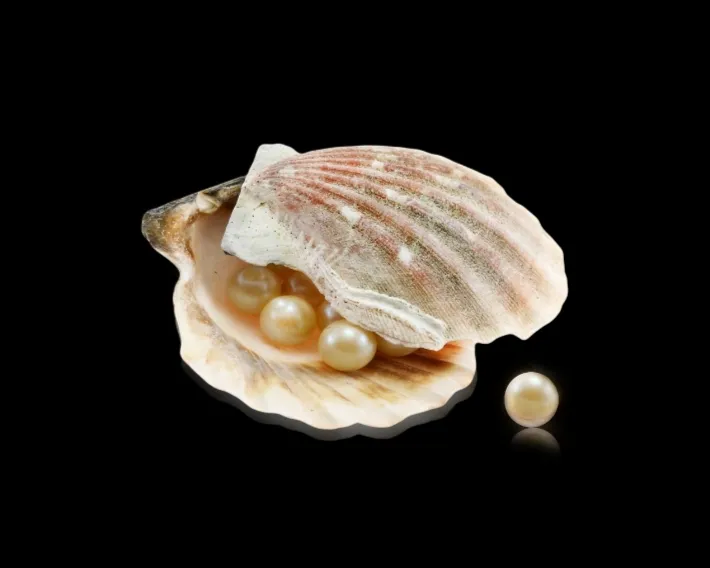
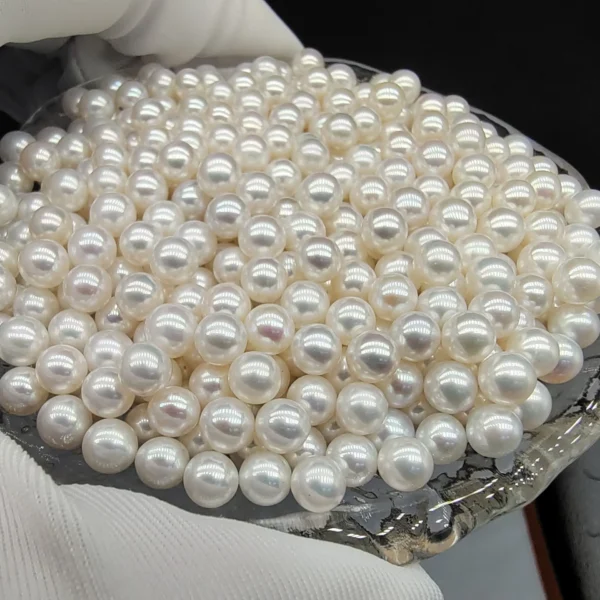
In the fourth winter, it's time to harvest.Wang brings the mature mussels to shore and piles them into wooden basins. Opening a mussel is a delicate art, too much force and you'll scratch the pearl; too little and the shell won't budge.He slides his knife along the shell's edge. Pop. The shell opens.Inside, nestled in the soft flesh, lies a pearl. Round. Luminous. Its surface glows with a soft, misty sheen — like morning fog drifting over Lake Taihu. Wang picks it up with tweezers and places it in his palm. The pearl is still warm from the mussel's body. In the winter sunlight, it shimmers with a faint pink overtone."This one's a beauty," he says, the corners of his eyes crinkling.This single pearl took four years to grow. Wang has been on this lake for forty
The Artisans of Suzhou
The pearl leaves the lake and travels to a jewelry workshop in Suzhou's old town.Suzhou has been a center of fine craftsmanship for centuries. During the Ming and Qing dynasties, the city's jade carvers, goldsmiths, and inlay artists were considered the best in the empire. A pearl doesn't complete its journey until it passes through their hands.
A master craftsman puts on his loupe and begins grading. He examines luster, roundness, surface quality, and color. Each pearl has its own personality — his job is to find the perfect place for it.Then comes drilling, stringing, knotting, and clasping. Every step is done by hand. The thread is custom-made silk, strong, smooth, and resistant to fraying. Between every two pearls, the craftsman ties a small knot. This prevents the pearls from rubbing against each other and ensures that if the string ever breaks, only one pearl falls off instead of the whole strand. A single necklace, forty to fifty pearls, takes half a day to string by hand.
From Suzhou to the World
Finally, the pearl necklace is placed in a velvet box and labeled: Taihu Freshwater Pearl, Suzhou, China. It might end up in a jewelry store in Suzhou, bought by a bride for her wedding day. Or it might be packed into a shipping container, cross the Pacific, and appear in a boutique window in Paris, New York, or Tokyo.But no matter where it goes, it carries with it the water of Lake Taihu, the wind of Suzhou, the warmth of Wang's hands, and the precision of the master craftsman's loupe. My grandfather was right. There really are treasures hidden beneath the lake. But the real treasure isn't just the pearl itself — it's the invisible labor and patience that carried it from the lake bottom to your fingertips.
A Note from the Author
I was born in Suzhou, on the shores of Lake Taihu. Now I run a pearl business. Every time I see a customer wearing one of our pearls, I think of my grandfather's words, Wang's boat, and the craftsman's loupe. A pearl travels four years and thousands of miles from the lake to your jewelry box.But it's worth every moment.